
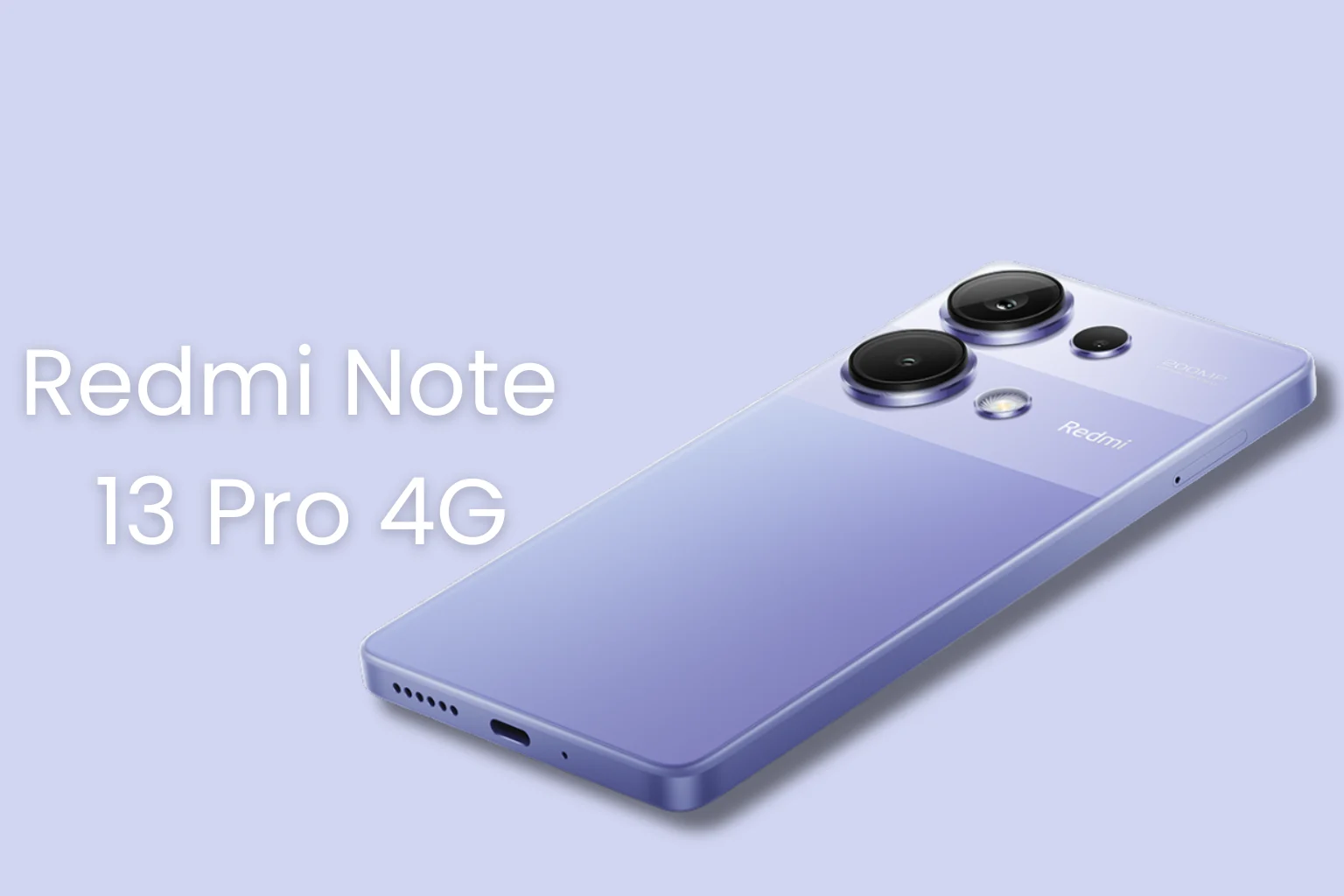
Redmi Note 13 Pro 4G price in Nepal starts at NPR 34,999 for the 8GB RAM and 256GB storage variant. The phone launched in Nepal on February 5, 2024, alongside the rest of the Redmi Note 13 series. It is officially available at authorized Xiaomi dealers across Nepal with one year of warranty. Key highlights include a 6.67-inch AMOLED display with 1300 nits peak brightness, MediaTek Helio G99 Ultra chipset, 200MP main camera with OIS, 5000mAh battery with 67W fast charging, IP54 splash resistance, microSD card slot, headphone jack, NFC, and IR blaster.
| Key Spec | Detail |
|---|---|
| Display | 6.67-inch AMOLED FHD+, 120Hz, 1300 nits peak |
| Chipset | MediaTek Helio G99 Ultra (6nm) |
| RAM and Storage | 8GB/256GB | 12GB/512GB |
| Main Camera | 200MP (OIS) + 8MP (ultrawide) + 2MP (macro) |
| Front Camera | 16MP |
| Battery | 5000mAh, 67W wired (0 to 100% in ~47 min) |
| OS | Android 13, HyperOS (2 major OS updates) |
| Water Resistance | IP54 (dust and splash resistant) |
| Price in Nepal | NPR 34,999 (8/256GB) | NPR 39,999 (12/512GB) |
| Nepal Launch | February 5, 2024 |
Who Should Buy the Redmi Note 13 Pro 4G
If you are a heavy photographer who wants a 200MP camera under NPR 40,000 and does not care about 5G, this phone was built for you. The 200MP main sensor with OIS is the main reason to choose the Note 13 Pro 4G over everything else at this price range in Nepal. No other phone under NPR 35,000 in Nepal gives you a camera sensor this capable.
It also makes sense if you want a phone packed with practical extras that most competitors skip at this price. The headphone jack is there. The IR blaster is there. MicroSD support for up to 1TB is there. NFC is there. 67W fast charging with the charger in the box is there. At NPR 34,999, getting all of these together in one phone is genuinely good value.
Skip it if 5G matters to you. Nepal’s 5G coverage is still limited in 2026, but if you are thinking about future-proofing, the Note 13 Pro 4G has no path to 5G. Also skip it if gaming performance is your top priority. The Helio G99 Ultra is a capable chip for daily use but it is a generation behind competing mid-range chips at the same price. Reviewers from Nextpit and Notebookcheck both noted the chip shows its age under heavy load.
Redmi Note 13 Pro 4G Global Launch Date and Nepal Availability
Xiaomi announced the Redmi Note 13 series globally on January 15, 2024. The Nepal launch took place on February 5, 2024, covering the Redmi Note 13 4G, Redmi Note 13 Pro 4G, and Redmi Note 13 Pro Plus together. The phone is available at authorized Xiaomi and Redmi stores across Nepal. It comes with one year of official warranty. The Redmi Note 13 Pro 5G is not officially available in Nepal. Only the 4G variant is the official Nepal model.
Full Specifications of Redmi Note 13 Pro 4G
General
- Model: Redmi Note 13 Pro 4G
- Announced: January 15, 2024 (Global)
- Launched in Nepal: February 5, 2024
- Size: 161.2 x 75 x 8 mm
- Weight: 188 g
- Build: Gorilla Glass 5 front and back, plastic frame
- SIM: Dual Nano-SIM + microSD (shared slot, up to 1TB)
- Water Resistance: IP54 (dust and splash resistant)
- Colors: Midnight Black, Lavender Purple, Forest Green
Display
- Size: 6.67 inches
- Type: AMOLED, 10-bit, 1 billion colors, HDR10+
- Resolution: FHD+ (1080 x 2400 pixels), 395 PPI
- Refresh Rate: 120Hz
- Peak Brightness: 1300 nits
- Typical Brightness: 500 nits
- PWM Dimming: 2160Hz (reduces eye strain at low brightness)
- Protection: Corning Gorilla Glass 5
- Wet Touch Technology: Prevents accidental touch in wet conditions
Performance
- Chipset: MediaTek Helio G99 Ultra (6nm)
- CPU: Octa-core (2x 2.2GHz Cortex-A76 + 6x 2.0GHz Cortex-A55)
- GPU: Mali-G57 MC2
- RAM: 8GB or 12GB LPDDR4X
- Storage: 256GB or 512GB UFS 2.2
- Expandable Storage: Yes, microSD up to 1TB (shared with SIM 2 slot)
- AnTuTu Score: Approximately 450,000
Camera
- Main Camera: 200MP, f/1.65, OIS, Samsung ISOCELL HP3 sensor, PDAF
- Ultra Wide Camera: 8MP, f/2.2
- Macro Camera: 2MP, f/2.4
- Rear Video: 1080p at 60fps (no 4K video)
- Front Camera: 16MP, f/2.4
- Front Video: 1080p at 30fps
- AI Features: AI portrait, night mode, document scanner
Audio
- Speaker: Single bottom-firing speaker
- Headphone Jack: Yes, 3.5mm
- IR Blaster: Yes
Connectivity
- Network: 4G LTE, 3G, 2G (no 5G)
- WiFi: Wi-Fi 5 (802.11ac), dual-band
- Bluetooth: 5.2
- NFC: Yes
- GPS: GPS, GLONASS, Galileo, BDS
- USB: USB Type-C 2.0, OTG
- IR Blaster: Yes
Battery
- Battery Capacity: 5000mAh
- Wired Charging: 67W (0 to 100% in approximately 47 minutes)
- Wireless Charging: Not supported
- Charger Included: Yes, 67W charger in box
Software
- Operating System: Android 13 at launch, upgradeable to HyperOS
- Interface: HyperOS (updated from MIUI 14)
- Software Updates: 2 major Android OS upgrades
- Security Updates: 4 years of security patches
Security and Sensors
- Fingerprint: Under-display optical fingerprint sensor
- Face Unlock: Yes
- Sensors: Accelerometer, gyroscope, proximity, compass
Detailed Review of Redmi Note 13 Pro 4G
Design and Build Quality
The Redmi Note 13 Pro 4G has a clean, straightforward design that does not try to do anything dramatic. The flat display and flat back make it practical to use and easy to put a case on. Both the front and back are covered in Gorilla Glass 5, which is solid protection for a phone at this price. The plastic frame is standard for the category.
At 8mm thick and 188 grams, it sits comfortably in hand without feeling bulky. The Forest Green and Lavender Purple color options look noticeably nicer in person than they do in product photos, which is something multiple reviewers mentioned. The Midnight Black is the safe, clean option if you want something understated.
The IP54 rating means it handles dust and water splashes without issues. Rain, accidental drops near a sink, and dusty environments in Nepal are all covered. It is not rated for submersion, so you would not want to drop it in a pond. For everyday real-world use in Nepal, IP54 is adequate but clearly weaker than the IP68 options available at higher price points like the Redmi Note 15 Pro 5G.
One feature worth calling out specifically for Nepal buyers: this phone has a headphone jack, an IR blaster, and a microSD slot all together. Many phones at this price have dropped one or more of these. If you still use wired earphones, want to control your TV or AC with your phone, and want to expand storage cheaply with a memory card, the Note 13 Pro 4G covers all three at once.
Performance
This is the most honest part of this review. The Helio G99 Ultra is a 6nm chip, but it is not a new chip. It is essentially the same silicon that has been around since 2022, and by 2024 standards it is noticeably behind competing chips at similar price points. The AnTuTu score sits around 450,000, which is lower than the Snapdragon 7s Gen 3 in the Nothing Phone 3a (around 812,000) and the Dimensity 7400 Ultra in the Redmi Note 15 Pro 5G.
For everyday tasks, this limitation is not as obvious as the numbers suggest. Opening apps, browsing, social media, video streaming, and messaging all feel smooth in normal use. Notebookcheck reviewers confirmed that navigation through menus works without problems in most cases. The difference only becomes noticeable during multitasking with many apps, or when running more demanding apps simultaneously.
For gaming, the situation is mixed. Casual games like Free Fire run fine. PUBG Mobile handles medium settings without problems. But the chip struggles under sustained heavy load. Genshin Impact at medium settings drops frame rates after extended play and the phone surface can reach up to 40 degrees Celsius during long sessions, which is warm but manageable. If you game heavily every day at maximum settings, this chip will frustrate you over time. For casual or occasional gaming, it is fine.
One important note: the Redmi Note 13 Pro 4G does not support 4K video recording. Video tops out at 1080p 60fps. If you shoot a lot of video and want 4K, this is a clear limitation that you should know before buying.
Software
The phone launched with Android 13 and MIUI 14, and has since received an update to HyperOS. Xiaomi promises 2 major Android OS updates and 4 years of security patches. The 2-year OS update window is on the shorter side compared to what Samsung and Google now offer at various price points, but it is consistent with what Xiaomi provides across its mid-range lineup.
HyperOS is cleaner than older MIUI versions and navigation feels more organized. However, the phone ships with a significant amount of pre-installed apps, including several advertising apps and games. Most can be uninstalled or disabled, but it takes some time to clean up after initial setup. PhoneArena also flagged a persistent issue with push notifications on MIUI-based phones, where the system aggressively kills background apps and delays notifications until you unlock the phone. This is a known Xiaomi software issue that has been present for multiple generations and affects messaging apps you rely on for real-time alerts.
Display Performance
The 6.67-inch AMOLED display is one of the best things about this phone. At 1300 nits peak brightness, outdoor visibility in Nepal’s sunlight is good. The 120Hz refresh rate keeps scrolling smooth. The 10-bit panel with 100% DCI-P3 color coverage makes photos, videos, and social media content look vivid and accurate.
The 2160Hz PWM dimming is a practical eye comfort feature. When you use the phone in dark environments with brightness turned low, the high-frequency dimming reduces visible flicker that can cause eye strain. This is something even more expensive phones sometimes skip. Wet Touch technology also means the display continues to work accurately when your fingers are slightly wet, which is useful during Nepal’s monsoon season.
Camera Performance
The 200MP main camera is the reason most people will choose this phone, and it delivers genuinely good results for the price. The Samsung ISOCELL HP3 sensor is a quality component with OIS for stabilization. Daylight photos come out detailed, with accurate colors and good dynamic range. The 200MP mode captures photos with extreme detail that holds up well when cropped, effectively giving you some digital zoom capability without a dedicated lens.
Low-light photography from the main sensor is solid for a mid-range phone. Night mode lifts shadows and controls noise better than most phones at this price. OIS helps keep shots sharp in dim conditions even without a tripod. For Nepal users who shoot street photos, family gatherings, and travel photography in varying light, the main camera performs reliably.
The 8MP ultrawide is functional but not a highlight. Sharpness drops noticeably at the edges and colors shift slightly compared to the main camera. The 2MP macro is essentially useless for anything other than extreme close-up decoration shots. Most users will rely almost entirely on the main camera and ultrawide for anything practical.
The front 16MP camera takes acceptable selfies in daylight. Portrait mode produces reasonable background blur without extreme edge processing artifacts. Low-light selfies are average. The front camera is not a reason to choose this phone, but it is not a reason to avoid it either.
One hard limitation to be clear about: the Redmi Note 13 Pro 4G does not record 4K video. The maximum rear video quality is 1080p at 60fps. If video recording quality matters to you and you want 4K, you need to look at other options. This is a notable omission for a phone with a 200MP camera.
Audio and Extra Features
The speaker setup is a single bottom-firing driver, which is a step down from the stereo setups found on competing phones at similar prices. Volume is adequate indoors but feels thin outdoors. This is one area where the phone clearly trades off against rivals. The 3.5mm headphone jack compensates for this if you prefer wired audio. The jack sounds clean and handles standard earphones without issues.
The IR blaster is a genuinely useful addition for Nepal. Using the phone as a remote for your TV, AC, fan, and set-top box through Xiaomi’s Mi Remote app saves you from hunting for multiple remotes. The microSD slot is also worth highlighting again. Being able to add 256GB or 512GB of extra storage for a few hundred rupees is something many competing phones at this price no longer offer.
Battery and Charging
The 5000mAh battery delivers solid all-day performance for most users. Under moderate use including social media, video, calls, and some camera use, the phone comfortably reaches end of day with battery remaining. Heavy users who game and use the camera heavily will need to charge daily. Battery efficiency is lower than expected given the chip, which reviewers from Nextpit noted is a consequence of the Helio G99 Ultra’s age and power efficiency compared to newer 4nm chips.
The 67W fast charging is the strongest battery-related feature. From 0 to 100 percent takes approximately 47 minutes according to PhoneArena’s testing, which is fast for a phone at this price. In 30 minutes, you can reach around 75 percent. The 67W charger comes in the box, which is a meaningful advantage over phones that ship with a slower charger or no charger at all. There is no wireless charging support.
Redmi Note 13 Pro 4G vs Competitors in Nepal
| Feature | Redmi Note 13 Pro 4G | Samsung Galaxy A36 5G | Nothing Phone 3a |
|---|---|---|---|
| Price (Nepal) | NPR 34,999 (8/256GB) | NPR 53,999 (8/128GB) | NPR 53,999 (8/128GB) |
| Display | 6.67″ AMOLED 120Hz, 1300 nits | 6.7″ AMOLED 120Hz, 1900 nits | 6.77″ AMOLED 120Hz, 3000 nits |
| Chipset | Helio G99 Ultra (6nm) | Snapdragon 6 Gen 3 (4nm) | Snapdragon 7s Gen 3 (4nm) |
| Main Camera | 200MP OIS | 50MP OIS | 50MP, telephoto 50MP 2x |
| 4K Video | No (max 1080p) | Yes | Yes (main only) |
| Battery | 5000mAh, 67W | 5000mAh, 45W | 5000mAh, 50W |
| Charger in Box | Yes (67W) | Verify at purchase | No |
| Water Resistance | IP54 | IP67 | IP64 |
| MicroSD Slot | Yes (up to 1TB) | No | No |
| Headphone Jack | Yes | No | No |
| 5G | No | Yes | Yes |
| Android Updates | 2 major | 6 major | 3 major |
The Redmi Note 13 Pro 4G costs NPR 19,000 less than both the Samsung Galaxy A36 5G and Nothing Phone 3a. That price gap is significant. You get a 200MP camera with OIS, 67W fast charging with a charger in the box, microSD support, and a headphone jack. The Galaxy A36 5G wins on 5G, water resistance, display brightness, software support (6 years), and processor performance. The Nothing Phone 3a wins on chipset and telephoto camera. If budget is the primary concern and camera quality is the priority, the Note 13 Pro 4G delivers impressive camera specs at a price neither rival can match.
Common User Issues with Redmi Note 13 Pro 4G
The push notification issue is the most documented complaint. MIUI and HyperOS aggressively kill background apps, which means notifications from messaging apps like WhatsApp and Telegram are often delayed until you open the phone. This requires manual tweaking of battery saving settings for each app. The Helio G99 Ultra chip shows noticeable slowdown under heavy multitasking. No 4K video is a significant omission for a 200MP camera phone at this price. IP54 water resistance is weaker than most competitors. Some units received a significant number of pre-installed apps and bloatware that take time to clean. The single speaker is underwhelming for media consumption. Software support at 2 major Android updates is short for a phone bought in 2024, with updates expected to end around Android 15.
Redmi Note 13 Pro 4G Price and Availability in Nepal
The Redmi Note 13 Pro 4G launched in Nepal on February 5, 2024, and is available at authorized Xiaomi and Redmi dealers across Nepal. It comes with one year of official warranty. Always purchase from an authorized seller to ensure an MDMS-registered device with a proper VAT bill. Avoid grey market units that skip warranty registration.
Redmi Note 13 Pro 4G Price in Nepal
- 8GB RAM and 256GB Storage: NPR 34,999
- 12GB RAM and 512GB Storage: NPR 39,999
The 8GB and 256GB variant at NPR 34,999 is excellent value for most users. 256GB base storage combined with microSD expansion up to 1TB means you will never run out of space. The 12GB variant is worth considering only if you run many heavy apps simultaneously.
Pros and Cons of Redmi Note 13 Pro 4G
Pros
- 200MP main camera with OIS at NPR 34,999 is unmatched in this price range
- 67W fast charging fills the phone in about 47 minutes
- 67W charger included in the box
- 256GB base storage included, no need to buy extra storage immediately
- MicroSD expansion up to 1TB available
- Headphone jack present
- IR blaster for TV and AC remote control
- NFC for contactless payments
- Bright 6.67-inch AMOLED with 1300 nits peak brightness
- 2160Hz PWM dimming for comfortable low-brightness use
- Lightweight at 188g with clean design
Cons
- No 4K video recording, maximum is 1080p at 60fps
- Helio G99 Ultra is an older chip, slower than competing 4nm processors
- No 5G support
- Only 2 major Android OS updates
- IP54 is weaker than IP67 and IP68 on competitors
- Push notification delays due to aggressive background app killing
- Single bottom-firing speaker, no stereo
- 2MP macro camera adds no real photographic value
- Significant pre-installed bloatware needs manual cleaning
Final Verdict on Redmi Note 13 Pro 4G
The Redmi Note 13 Pro 4G makes the most sense for one type of Nepal buyer: someone on a budget under NPR 40,000 who wants the best camera they can get and is not particularly concerned about 5G or long-term software support.
The 200MP camera with OIS at NPR 34,999 is genuinely remarkable. You are getting a sensor quality that phones at twice this price were offering just a couple of years ago. The 67W fast charging with the charger in the box, 256GB base storage, microSD support, headphone jack, and NFC together make this one of the most feature-complete phones available at this price in Nepal.
The honest limitations are real though. The Helio G99 Ultra is not a fast chip by 2024 standards. No 4K video is a painful omission for a 200MP camera phone. Software updates end after 2 major versions. Push notifications need manual fixing. If these trade-offs are acceptable for your use case, the Note 13 Pro 4G delivers more camera and more features per rupee than almost anything else available under NPR 40,000 in Nepal.
Frequently Asked Questions about Redmi Note 13 Pro 4G in Nepal
What is the price of Redmi Note 13 Pro 4G in Nepal?
The Redmi Note 13 Pro 4G price in Nepal is NPR 34,999 for the 8GB RAM and 256GB storage variant. The 12GB RAM and 512GB storage version costs NPR 39,999. It is available at authorized Xiaomi dealers across Nepal.
When did the Redmi Note 13 Pro 4G launch in Nepal?
The Redmi Note 13 Pro 4G launched in Nepal on February 5, 2024, as part of the Redmi Note 13 series Nepal launch. The global announcement was on January 15, 2024.
Does the Redmi Note 13 Pro 4G support 4K video?
No. The Redmi Note 13 Pro 4G does not record 4K video. The maximum video resolution is 1080p at 60fps on the rear camera. This is a notable limitation for a phone with a 200MP main camera. If 4K video is important to you, consider the Redmi Note 15 Pro 5G at a higher price.
How good is the 200MP camera on Redmi Note 13 Pro 4G?
The 200MP main camera with OIS uses the Samsung ISOCELL HP3 sensor and delivers genuinely good daylight photos with strong detail and accurate colors. Low-light photography is solid for this price range. The camera is the strongest reason to buy this phone. The 8MP ultrawide and 2MP macro are significantly weaker. There is no telephoto lens.
How fast does the Redmi Note 13 Pro 4G charge?
The Redmi Note 13 Pro 4G supports 67W fast charging and goes from 0 to 100 percent in approximately 47 minutes. In 30 minutes, it reaches around 75 percent. The 67W charger is included in the box.
Does the Redmi Note 13 Pro 4G have a headphone jack?
Yes. The Redmi Note 13 Pro 4G has a 3.5mm headphone jack. This is increasingly rare at this price range and is one of the practical advantages of this phone for users who prefer wired audio.
Does the Redmi Note 13 Pro 4G support a memory card?
Yes. The Redmi Note 13 Pro 4G has a microSD card slot that supports cards up to 1TB. The slot is shared with the second SIM card, meaning you can use either a second SIM or a microSD card, not both at the same time.
Is the Redmi Note 13 Pro 4G waterproof?
The Redmi Note 13 Pro 4G has an IP54 rating, which covers protection against dust and water splashes from any direction. It is not rated for submersion. For daily use in light rain and Nepal’s monsoon season, IP54 provides adequate protection. For stronger water resistance, consider the Redmi Note 15 Pro 5G which carries IP68 and IP69K ratings.
Where can I buy the Redmi Note 13 Pro 4G in Nepal?
The Redmi Note 13 Pro 4G is available at authorized Xiaomi and Redmi dealers and mobile stores across Nepal. Always buy from an authorized seller with an MDMS-registered device and a proper VAT bill to ensure official warranty coverage.


