
Last Updated: 16 June, 2026
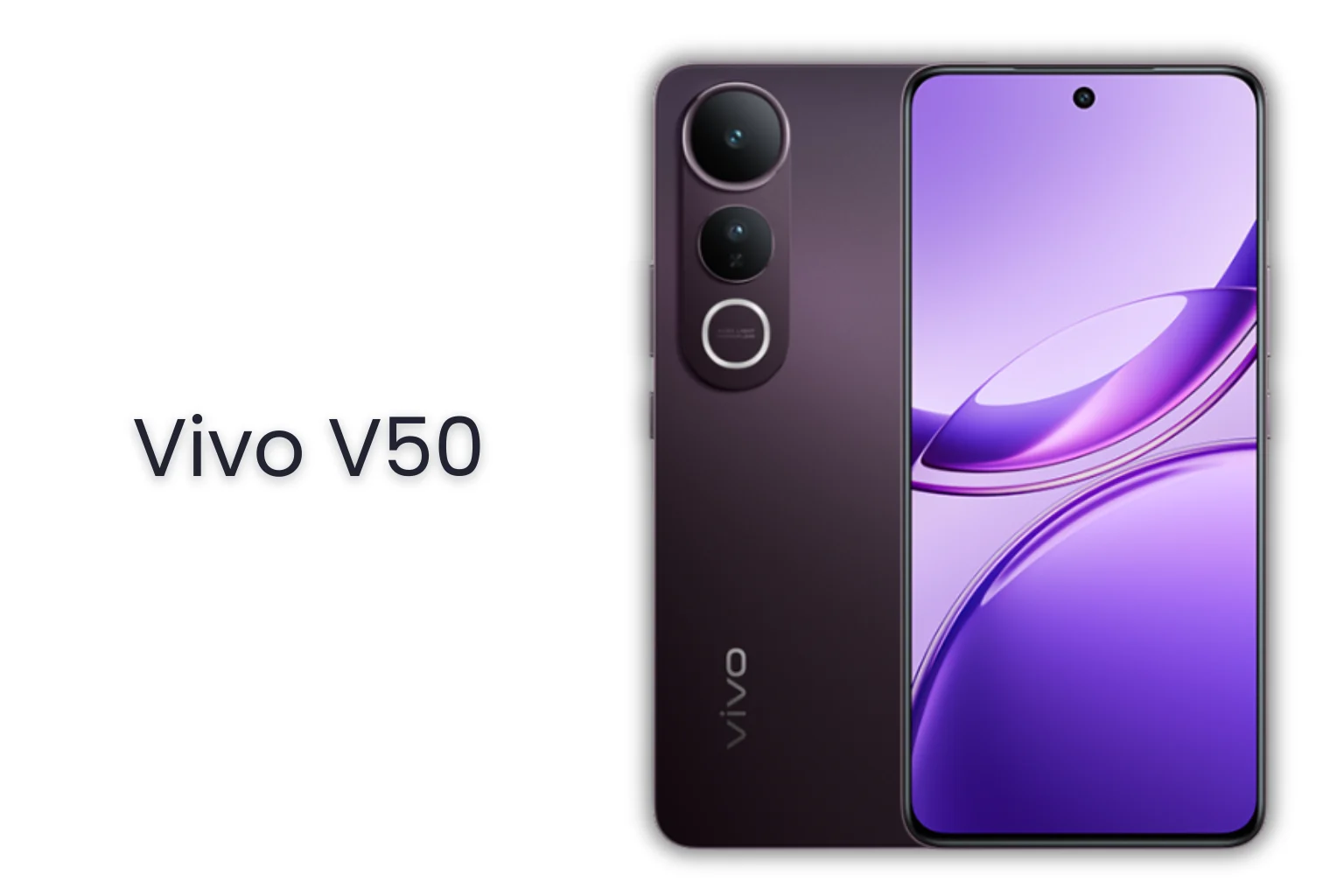
Vivo V50 price in Nepal is NPR 67,999 for the sole 12GB RAM and 512GB storage variant. Price confirmed from authorized Vivo Nepal sources as of May 2026. The phone launched globally on February 17, 2025, and became available in Nepal in March 2025. It’s the V-series predecessor to the Vivo V60 and focuses on Zeiss dual cameras, a 6000mAh silicon carbon battery, and a quad-curved AMOLED display. Key specs: 6.77-inch FHD+ AMOLED at 120Hz with 4500 nits peak brightness, Snapdragon 7 Gen 3 chipset, dual 50MP Zeiss cameras with OIS on both lenses, 6000mAh battery with 90W charging, IP68 and IP69 dual water resistance, and Funtouch OS 15 on Android 15.
Worth knowing before you buy:
- The Vivo V60 launched in Nepal at NPR 70,999, just NPR 3,000 more than the V50. The V60 adds a 3x periscope telephoto and 6500mAh battery. Before buying the V50, compare both directly since the price gap is minimal.
- No telephoto lens. Both rear cameras are wide-angle: a 50MP main and a 50MP ultrawide. Zoom photography relies entirely on digital cropping.
- No eSIM support. Real reviewers flagged this as a notable omission for frequent travellers who switch between physical SIM cards internationally.
- The ultrawide camera uses 50MP and autofocus, which is genuinely better than the 8MP ultrawide on most competing phones at this price. The camera quality gap between main and ultrawide is much smaller than on most rivals.
| Key spec | Detail |
|---|---|
| Display | 6.77-inch FHD+ AMOLED, 120Hz, 4500 nits peak, quad-curved, HDR10+ |
| Chipset | Qualcomm Snapdragon 7 Gen 3 (4nm) |
| RAM and storage | 12GB/512GB (sole Nepal variant) |
| Main camera | 50MP (f/1.88, OIS, 1/1.55-inch) + 50MP ultrawide (f/2.2, OIS, autofocus) |
| Front camera | 50MP (f/2.0, 92-degree FOV) |
| Battery | 6000mAh Silicon Carbon (BlueVolt), 90W wired |
| OS | Android 15, Funtouch OS 15 (3 major OS updates, 3 years security) |
| Water resistance | IP68 and IP69 (triple waterproof rated) |
| Price in Nepal | NPR 67,999 (12/512GB) |
| Nepal availability | March 2025 | Price last verified: May 2026 |
Who should buy the Vivo V50
After researching every phone between NPR 60,000 and NPR 75,000 officially available in Nepal, the Vivo V50 makes the strongest case for portrait and everyday photographers who want Zeiss camera quality, a large battery, and strong water resistance without crossing NPR 70,000.
The dual 50MP Zeiss cameras are the main reason to choose this phone. Having OIS on both the main and ultrawide lens is unusual at this price. Real reviewers across multiple publications described the camera as one of their favourites on any mid-range phone in 2025. The Zeiss Biotar, Sonnar, and Distagon bokeh modes, Film Camera mode, and three portrait focal lengths at 23mm, 35mm, and 50mm give creative photographers genuinely useful tools that most competing phones don’t offer.
The 6000mAh silicon carbon battery delivering 11 hours of screen-on time in real-world testing is another strong reason. For Nepal users who need their phone through long days without charging access, this battery delivers.
Skip it if you need zoom photography. There’s no telephoto lens. Both rear cameras are wide-angle. Also consider skipping it for the Vivo V60 at NPR 70,999, just NPR 3,000 more, which adds a 3x periscope telephoto and a larger 6500mAh battery. The V50 makes sense if you specifically want the dual 50MP ultrawide with OIS over a telephoto lens.
Vivo V50 global launch date and Nepal availability
Vivo announced the V50 globally on February 17, 2025, and released it from February 25, 2025, in India. Nepal received the phone in March 2025 through authorized Vivo dealers. The Nepal variant is the 12GB/512GB version only. No other storage configuration is officially sold here. One year of official warranty includes 30 days free replacement for functional faults and 6 months free repair on battery and accessories. Price confirmed from authorized Vivo Nepal sources as of May 2026.
Full specifications of Vivo V50
General
- Model: Vivo V50 5G
- Announced: February 17, 2025 (Global)
- Released globally: February 25, 2025
- Available in Nepal: March 2025
- Size: 162.4 x 75.6 x 7.19 mm
- Weight: 187 g
- Build: AG glass back (anti-glare), aluminum frame, glass front
- SIM: Dual Nano-SIM (no eSIM, no microSD slot)
- Water resistance: IP68 and IP69 (also IP65)
- Colors: Titanium Grey, Rose Red, Starry Night
- Display curvature: Quad-curved, 41-degree curvature, 1.86mm bezels
Display
- Size: 6.77 inches
- Type: AMOLED, FHD+, HDR10+, quad-curved
- Resolution: 1080 x 2392 pixels, 388 PPI
- Refresh rate: 120Hz
- Peak brightness: 4500 nits
- Protection: Schott Xensation glass
- Eye comfort: TUV Rheinland certified
Performance
- Chipset: Qualcomm Snapdragon 7 Gen 3 (4nm)
- CPU: Octa-core (1x 2.63GHz Cortex-A715 + 4x 2.4GHz Cortex-A715 + 3x 1.8GHz Cortex-A510)
- GPU: Adreno 720
- RAM: 12GB LPDDR5X
- Storage: 512GB UFS 3.1
- Expandable storage: No microSD slot
Camera
- Main camera: 50MP, f/1.88, OIS, 1/1.55-inch sensor, PDAF
- Ultrawide camera: 50MP, f/2.2, OIS, autofocus, 119-degree FOV
- No telephoto camera
- Zeiss features: Zeiss T* lens coating, Zeiss Natural/Vivid/Texture filters, Zeiss Biotar/Sonnar/Distagon/Planar bokeh modes, Film Camera mode
- Portrait focal lengths: 23mm, 35mm, 50mm
- Rear video: 4K at 30fps, 1080p at 60fps
- Front camera: 50MP, f/2.0, 92-degree FOV
- Front video: 1080p at 30fps
Audio
- Speaker: Dual stereo speakers
- Headphone jack: No
- Haptics: X-axis linear motor
Connectivity
- Network: 5G, 4G LTE, 3G, 2G
- WiFi: Wi-Fi 6 (802.11ax), dual-band (no Wi-Fi 7)
- Bluetooth: 5.4
- NFC: Yes
- GPS: GPS, GLONASS, Galileo, BDS
- USB: USB Type-C 2.0, OTG
- eSIM: No
- IR blaster: No
Battery
- Battery capacity: 6000mAh Silicon Carbon (BlueVolt)
- Wired charging: 90W (0 to 100% in approximately 60 minutes)
- Wireless charging: No
- Charger included: Yes, 90W charger in box
Software
- Operating system: Android 15, Funtouch OS 15
- Software updates: 3 major Android OS upgrades
- Security updates: 3 years of security patches
Security and sensors
- Fingerprint: Under-display optical fingerprint sensor
- Face unlock: Yes
- Sensors: Accelerometer, gyroscope, proximity, compass
Detailed review of Vivo V50
Design and build quality
The V50 is one of the slimmest phones at this price in Nepal. At 7.19mm thick with a quad-curved display and back, it feels more premium in hand than the specs suggest. The 41-degree display curvature and 1.86mm bezels give it an almost edge-to-edge appearance from the front. At 187g, it’s light enough to use one-handed comfortably for a 6.77-inch phone.
Schott Xensation glass covers the front, offering scratch and drop resistance comparable to Gorilla Glass Victus. The AG (anti-glare) glass back resists fingerprints better than glossy finishes on competing phones. The Starry Night color uses a 3D-star technology pattern that’s unique and visually striking in person.
IP68 and IP69 dual certification covers full submersion and high-pressure water jets. Real reviewers confirmed this handles water exposure confidently. No microSD slot and no eSIM are the practical limitations. The eSIM omission in particular was flagged by multiple reviewers as an oversight for a phone at this price targeting frequent travellers and professionals.
Performance
The Snapdragon 7 Gen 3 handles everyday tasks smoothly. Social media, streaming, WhatsApp, calls, and moderate multitasking all run without hesitation. The 12GB LPDDR5X RAM gives the phone strong background app retention, keeping more apps loaded simultaneously than phones with 8GB.
Gaming performance sits at the competent but not impressive end of the mid-range spectrum. Real reviewers described it as not blowing them out of the water with flagship-level performance but maintaining a respectable balance of heat management and frame rates. Battery drain during gaming at high settings ran at approximately 6 to 7 percent per 10 minutes. For casual to moderate gaming, the phone holds up. Heavy gamers who want to run demanding titles at maximum graphics for extended daily sessions will feel the chip’s limits within weeks.
The UFS 3.1 storage is adequate but not the fastest available. Phones like the POCO X7 Pro use UFS 4.0, which is noticeably quicker for large file operations. In daily use this is invisible. Only users who frequently transfer large video files or install large games will notice the difference.
Software: Funtouch OS 15
Funtouch OS 15 on Android 15 functions well for daily use. The interface is organized, settings are accessible, and navigation is clear. But it ships with pre-installed apps and some bloatware that needs manual cleanup after first setup. Expect 15 to 20 minutes of housekeeping on day one.
3 major Android updates and 3 years of security patches. This is better than the 2-year commitment Infinix offers on the GT 30 Pro but less than the 4 to 7 years offered by Samsung and OnePlus at similar prices. For a phone at NPR 67,999, real reviewers flagged this as a weakness that Vivo should address. The Vivo V60 at NPR 70,999 offers 4 years of OS updates for NPR 3,000 more.
Display performance
The 6.77-inch quad-curved AMOLED at 4500 nits peak brightness is one of the best displays available under NPR 75,000 in Nepal. At 4500 nits, it’s brighter than the Vivo V60 (5000 nits is the V60, but the V50 at 4500 nits still beats most competing phones significantly), the Samsung Galaxy S26 (2600 nits), and the POCO X7 Pro (3200 nits). Direct Nepal sunlight visibility is outstanding at this brightness.
The quad-curved design adds a premium feel that makes the screen feel wider than a flat-panel phone of the same size. 120Hz keeps scrolling smooth. HDR10+ makes streaming content look rich and accurate. Schott Xensation protection adds scratch resistance confidence. Real reviewers consistently described the display as a highlight of the phone, noting visuals as gorgeous during gaming and media consumption.
Camera performance
The camera is the strongest reason to buy the Vivo V50 and the most distinctive feature separating it from competing phones at this price.
The 50MP main camera with OIS and a 1/1.55-inch sensor takes excellent daylight photos. Zeiss T* lens coating reduces flare and improves color accuracy in harsh lighting. Colors through Zeiss Natural mode are accurate and true to what your eyes saw. Zeiss Vivid mode adds contrast for social media impact. The difference in rendering style between Natural and Vivid is immediately visible and genuinely useful depending on the shooting situation.
The 50MP ultrawide with OIS and autofocus is what truly sets this camera system apart from every competing phone at similar Nepal prices. Most phones at NPR 67,999 pair their main camera with an 8MP or 12MP ultrawide without OIS. The V50’s 50MP ultrawide with OIS and autofocus delivers wide-angle shots that match the main camera in resolution and hold up in low light in a way that smaller, unstabilized ultrawides physically can’t. This closes the quality gap between wide-angle and main camera shots that makes most mid-range phone photography feel inconsistent.
Portrait photography through Zeiss Biotar bokeh mode creates genuinely cinematic background blur with character that standard computational blur lacks. Film Camera mode produces Polaroid-style instant photos. The three focal lengths at 23mm, 35mm, and 50mm let portrait photographers compose shots the way they would with a dedicated camera. Real reviewers across multiple publications described this as one of the best mid-range camera packages of 2025.
Low-light performance from the main camera is strong. OIS keeps shots sharp in dim conditions without a tripod. Night mode brings out detail with controlled noise. Our research found multiple reviewers describing low-light results as capable and reliable.
The absence of a telephoto is the camera’s only real limitation. Zoom photography beyond the main camera’s field of view relies on digital cropping. The V60 at NPR 70,999 adds a 3x periscope telephoto for this purpose. If zoom photography is important to you, the NPR 3,000 premium for the V60 solves the gap.
Audio
Dual stereo speakers that get loud and clear. The X-axis linear motor adds tight haptic feedback. No headphone jack. Bluetooth 5.4 covers wireless audio. No IR blaster, which is available on the cheaper Vivo Y19s in Nepal at NPR 16,499.
Battery and charging
The 6000mAh silicon carbon BlueVolt battery is the second headline feature of the V50 alongside its cameras. Real-world testing confirmed approximately 11 hours of screen-on time, which one reviewer called exceptional for its class. Another reviewer noted better-than-day-long power, stretching to two full days with moderate use. Heavy gaming sessions consumed 6 to 7% per 10 minutes while the phone stayed cool.
90W charging fills the 6000mAh battery in approximately 60 minutes. The 90W charger comes in the box. For Nepal users who commute long distances, spend full days outdoors, or work in environments without easy charging access, this battery delivers outstanding real-world endurance. No wireless charging is available, which is expected at this price.
Vivo V50 vs competitors in Nepal
| Feature | Vivo V50 | Vivo V60 | Nothing Phone 3 |
|---|---|---|---|
| Price (Nepal) | NPR 67,999 (12/512GB) | NPR 70,999 (12/256GB) | NPR 99,999 (12/256GB) |
| Display | 6.77″ FHD+ AMOLED 120Hz, 4500 nits, quad-curved | 6.77″ AMOLED 120Hz, 5000 nits, quad-curved | 6.67″ AMOLED 120Hz |
| Chipset | Snapdragon 7 Gen 3 (4nm) | Snapdragon 7 Gen 4 (4nm) | Snapdragon 8s Gen 4 (4nm) |
| Main camera | 50MP OIS, 1/1.55-inch, Zeiss | 50MP OIS, Zeiss | 50MP OIS |
| Ultrawide | 50MP OIS, autofocus | 8MP (downgraded) | 50MP |
| Telephoto | No | 50MP 3x periscope OIS | 50MP 3x periscope OIS |
| Battery | 6000mAh, 90W (charger in box) | 6500mAh, 90W (charger in box) | 5150mAh, 65W (charger in box) |
| Ultrawide quality | 50MP OIS autofocus (best of three) | 8MP (weakest) | 50MP |
| Water resistance | IP68 and IP69 | IP68 and IP69 | IP68 |
| Android updates | 3 major | 4 major | 5 major |
| Base storage in Nepal | 512GB | 256GB | 256GB |
| Price difference | Baseline | NPR 3,000 more | NPR 32,000 more |
The V50 is NPR 3,000 cheaper than the V60 but wins on ultrawide camera quality (50MP OIS autofocus versus 8MP on V60) and base storage (512GB versus 256GB). The V60 wins on telephoto camera, battery capacity (6500mAh versus 6000mAh), software updates (4 versus 3 years), and a slightly newer chip. At NPR 3,000 difference, the choice between V50 and V60 depends entirely on whether you prioritize a strong ultrawide over a telephoto lens. The Nothing Phone 3 at NPR 99,999 costs NPR 32,000 more and offers a much faster Snapdragon 8s Gen 4 and 5 years of updates but has a smaller battery and costs significantly more. For Nepal buyers specifically after the best camera value under NPR 70,000, the V50’s dual 50MP Zeiss setup with OIS on both lenses is genuinely hard to beat.
Common user issues with Vivo V50
No telephoto camera makes zoom photography entirely reliant on digital cropping. No eSIM frustrates frequent travellers and dual-line professionals. No microSD slot means 512GB is the ceiling. No wireless charging. Funtouch OS 15 ships with bloatware requiring cleanup. Only 3 years of Android updates and security patches. No IR blaster. No Wi-Fi 7 despite competing phones at similar prices including it. Ultrawide can show edge softness in challenging low-light conditions. UFS 3.1 storage slower than UFS 4.0 on some competing phones.
Vivo V50 price and availability in Nepal
The Vivo V50 is available through authorized Vivo dealers across Nepal. It arrived in March 2025 and only the 12GB/512GB variant is officially sold here. One year of official warranty is included with 30 days free replacement for functional faults and 6 months free repair on battery and accessories. Price confirmed from authorized Vivo Nepal sources as of May 2026. Before purchasing, compare directly with the Vivo V60 at NPR 70,999 since the price gap is just NPR 3,000.
Vivo V50 price in Nepal
- 12GB RAM and 512GB storage: NPR 67,999
This is the only officially available variant in Nepal. The 512GB storage is generous and covers years of use for most buyers without needing to manage space. No option to expand with a microSD card exists.
Pros and cons of Vivo V50
Pros
- Dual 50MP Zeiss cameras with OIS on both main and ultrawide, best dual-camera setup under NPR 70,000 in Nepal
- 50MP ultrawide with autofocus and OIS, significantly better than 8MP ultrawides on competing phones
- Multiple Zeiss creative modes including Biotar, Sonnar, Distagon bokeh and Film Camera mode
- 6000mAh silicon carbon battery delivering 11 hours screen-on time in real testing
- 90W charging fills in approximately 60 minutes, charger in box
- 4500 nit quad-curved AMOLED, one of the brightest displays under NPR 75,000 in Nepal
- IP68 and IP69 dual water resistance
- 512GB base storage in Nepal variant
- Slim 7.19mm design at 187g
- Dual stereo speakers
- NFC for contactless payments
- 50MP front camera with wide 92-degree FOV
Cons
- No telephoto camera
- No eSIM support
- No microSD slot
- No wireless charging
- Only 3 major Android updates and 3 years security patches
- No IR blaster
- No Wi-Fi 7
- Funtouch OS 15 bloatware needs cleanup
- Snapdragon 7 Gen 3 shows limits in heavy gaming
- USB-C is USB 2.0 speed only
Final verdict on Vivo V50
The Vivo V50 earns its place in Nepal at NPR 67,999 for one specific buyer: someone who prioritizes camera quality above everything else and wants Zeiss-grade photography with OIS on both rear cameras, the strongest ultrawide available under NPR 70,000 in Nepal, and a battery that lasts two days without compromise.
The Snapdragon 7 Gen 3 is adequate for everyday use and casual gaming but not exceptional. The 3-year software update commitment is the weakest of any phone at this price in Nepal. No telephoto limits zoom photography entirely.
Before buying the V50, compare it directly with the Vivo V60 at NPR 70,999. For NPR 3,000 more you get a 3x periscope telephoto, a larger 6500mAh battery, 4 years of OS updates, and a newer chip. The V50 wins on ultrawide quality and base storage. That’s the honest trade-off to decide between.
If camera versatility including a strong ultrawide and Zeiss creative tools matters most to you, and zoom photography isn’t a priority, the Vivo V50 at NPR 67,999 is one of the strongest camera phones available in Nepal under NPR 70,000 right now.
Frequently asked questions about Vivo V50 in Nepal
What is the price of Vivo V50 in Nepal?
The Vivo V50 price in Nepal is NPR 67,999 for the sole 12GB RAM and 512GB storage variant. Price confirmed from authorized Vivo Nepal sources as of May 2026.
When did the Vivo V50 launch in Nepal?
The Vivo V50 launched globally on February 17, 2025, and became available in Nepal in March 2025 through authorized Vivo dealers.
How is the camera on Vivo V50?
The camera is the strongest reason to buy this phone. The dual 50MP Zeiss system with OIS on both the main and ultrawide cameras is genuinely one of the best dual-camera packages under NPR 70,000 in Nepal. Multiple independent reviewers described it as one of their favourite cameras on any mid-range phone in 2025. Zeiss Biotar bokeh modes, Film Camera mode, and three portrait focal lengths at 23mm, 35mm, and 50mm add creative flexibility that most competing phones don’t offer.
Does the Vivo V50 have a telephoto camera?
No. The Vivo V50 has two 50MP cameras: a main wide-angle and an ultrawide. There is no dedicated telephoto or zoom lens. Digital cropping from the 50MP main sensor provides some zoom capability but not true optical zoom. For optical zoom at a similar price, the Vivo V60 at NPR 70,999 adds a 50MP 3x periscope telephoto for NPR 3,000 more.
What makes the Vivo V50 ultrawide camera special?
The V50’s ultrawide is a 50MP sensor with both OIS and autofocus, which is very unusual at this price. Most competing phones use 8MP to 12MP ultrawides without OIS or autofocus. The V50’s ultrawide can produce results close to the main camera quality in good light and holds up better in low light than smaller fixed-focus ultrawides on competing phones.
How long does the Vivo V50 battery last?
The 6000mAh silicon carbon BlueVolt battery delivered approximately 11 hours of screen-on time in real-world testing. Multiple reviewers described it as better than day-long endurance with moderate use stretching to two days. 90W charging fills from 0 to 100% in approximately 60 minutes. The charger comes in the box.
Is the Vivo V50 waterproof?
The Vivo V50 carries IP68 and IP69 dual water resistance certification. IP68 covers submersion up to 1.5 meters for 30 minutes. IP69 adds protection against high-pressure water jets. This is strong water protection for Nepal’s monsoon conditions and everyday outdoor use.
Should I buy Vivo V50 or Vivo V60 in Nepal?
The price gap is just NPR 3,000. The V60 at NPR 70,999 adds a 3x periscope telephoto camera, a larger 6500mAh battery, 4 years of OS updates versus 3, and a newer Snapdragon 7 Gen 4 chip. The V50 wins on ultrawide camera quality (50MP OIS autofocus versus 8MP on V60) and base storage (512GB versus 256GB). If you shoot wide-angle photography more than zoom, the V50’s ultrawide is better. If you need zoom capability, the V60 is worth the extra NPR 3,000.
Where can I buy the Vivo V50 in Nepal?
The Vivo V50 is available through authorized Vivo retail stores and mobile dealers across Nepal. Always buy from an authorized dealer to get an MDMS-registered device with official warranty and a proper VAT bill.


